Article
Last Updated: May 22, 2026
5 Misconceptions About Fair Use and AI: Key Takeaways from AI Progress Panel
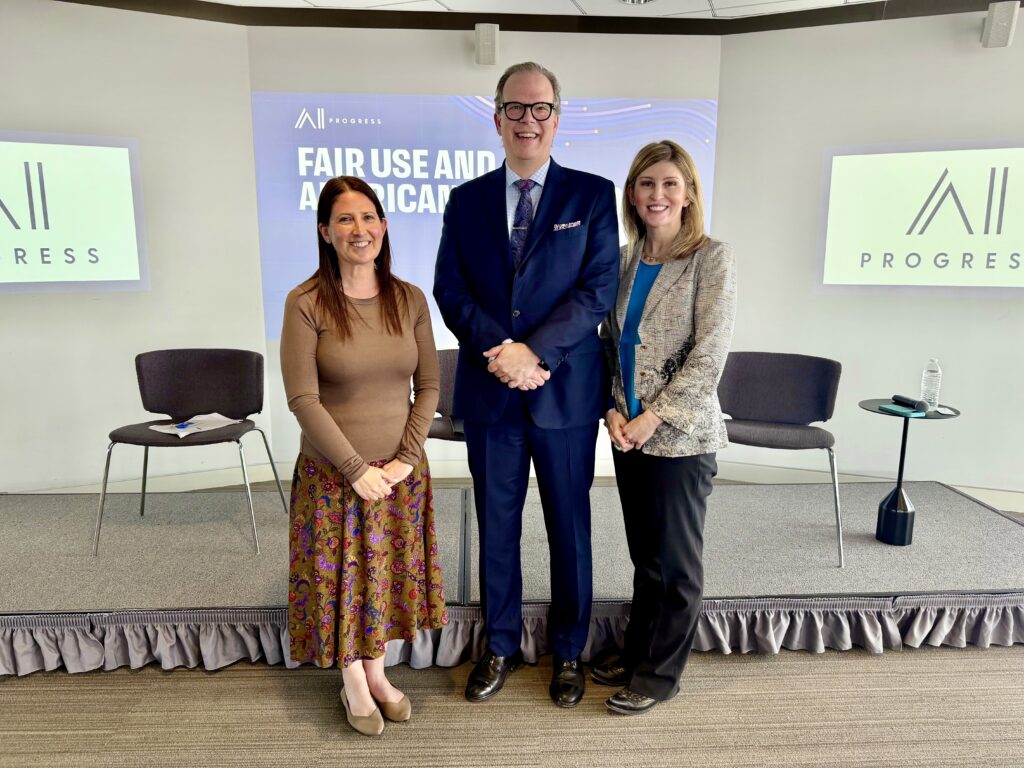
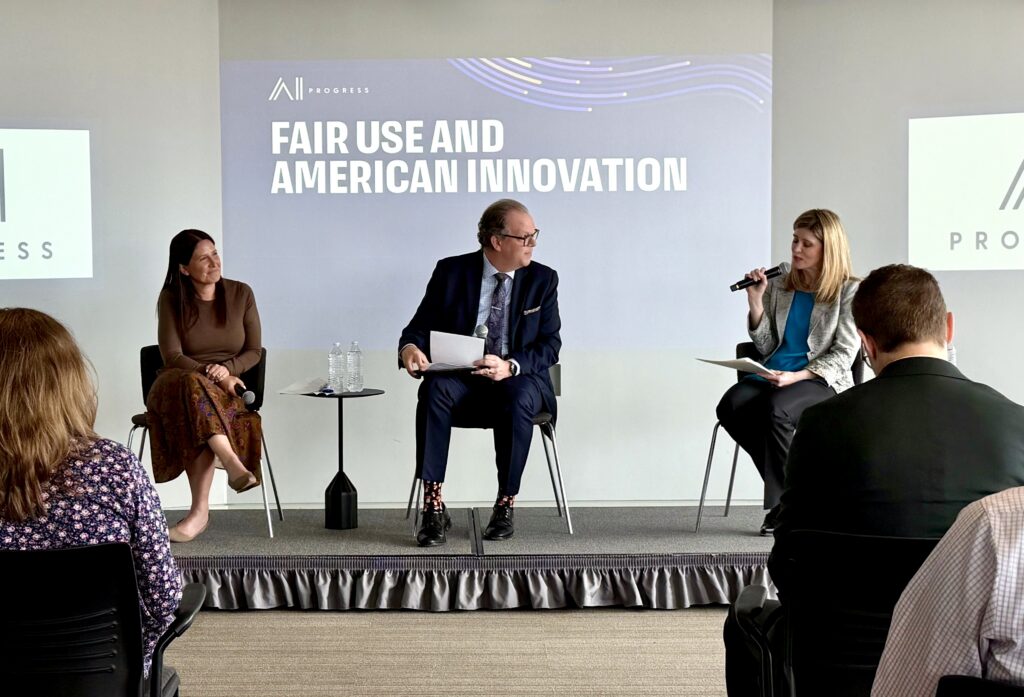
The conversation around AI and copyright is often framed as a standoff between developers and creators. But at a recent AI Progress event hosted at Microsoft’s Innovation & Policy Center in Washington D.C., panelists made clear the reality is far more nuanced, with implications across industries and institutions.
The discussion focused on whether the United States will preserve the legal framework that has supported generations of innovation — or introduce new uncertainty around access to data that is vital for AI training. It also brought together voices from different parts of the knowledge economy, underscoring that fair use is not just a tech issue. It is a research, access, and public interest issue.
“Fair use helps ensure that copyright supports, rather than obstructs, how knowledge and culture grow in this country, and remains essential for American leadership, both in innovation and in creative development,” said event moderator Anna Chauvet, AI Progress advisor and partner at Finnegan.
The big picture: Fair use gives developers, researchers, libraries, universities, and other institutions the legal clarity they need to build, study, preserve, and share knowledge. According to a recent CCIA report, industries that rely on fair use account for 18% of the U.S. economy, employ more than 22 million workers, and contribute roughly $4.9 trillion in GDP.
The stakes: Fair use underpins the knowledge framework that helps ideas circulate. Panelists argued that preserving it is critical to maintaining U.S. leadership in AI as other countries move quickly to shape the future of the technology.
Throughout the discussion, panelists pushed back on several misconceptions shaping the debate around AI and copyright — from how AI systems learn to whether existing copyright law can address emerging technologies:
1. Fair use is not a loophole — it is a core feature of U.S. copyright law.
For nearly 185 years, fair use has helped copyright law do two things at once: protect original expression and allow transformative innovation to flourish. Katzman argued that describing fair use as a loophole ignores the role it has long played in advancing innovation and enabling technologies that are now part of everyday life, including search engines, cloud storage, and book digitization.
“Copyright law is really essential to promoting the progress of science and useful arts in the U.S., and fair use is anything but a loophole,” Jenni Katzman, senior director of government affairs at Microsoft, said.
2. Fair use protections extend far beyond AI companies.
AI systems require broad and diverse datasets to learn patterns, understand relationships, and generate useful outputs. That access helps make systems more accurate, reliable, and responsive in real-world settings.
Andrew Pace, executive director of the Association of Research Libraries, emphasized that access to information is not just a commercial AI issue — it is also essential for research, scholarship, and education.
“Research in any field requires access to source materials that are relevant to the researcher and representative of the full scope of inquiry. So that’s really what we’re trying to do, is not limit that scope,” he said. “That’s important, not just to researchers and their institutions, but I would say to all of humanity, right? We want to spread as much knowledge as we can.”
3. AI training is transformative — not simple copying.
The panel addressed a persistent misunderstanding that AI systems merely store and reproduce copyrighted works. Katzman explained that large language models are designed to identify patterns and relationships across data — not act as copy machines. The goal, she said, is for models to understand concepts and relationships so they can generate something new.
“The purpose of training is so that AI understands these concepts and relationships, so that models can create something novel and new,” Katzman said.
4. Existing copyright law is capable of handling AI.
Panelists warned against rushing to create AI-specific copyright legislation that could narrow fair use, impose licensing mandates, or limit lawful access to information. Pace noted that the Library Copyright Alliance has argued existing copyright law is capable of addressing AI-related questions, adding that libraries have spent decades navigating licensing restrictions and access issues long before generative AI entered the picture.
“For decades, libraries have worked and pointed out that restrictive licenses can limit a researcher's scope of inquiry only to the public domain, which really limits the scope of research,” he said. “Many in the library profession still consider the training of ownership for licenses to be the original sin that got us to restrictive licensing and paywalls, but libraries have made a lot of progress in negotiating some of these licenses for terms that allow students and faculty to make comprehensive use of the digital materials that are out there.”
5. U.S. leadership in AI is strong — but not guaranteed.
The United States leads in AI in part because of its longstanding and flexible copyright framework. But panelists cautioned that the advantage could erode if policymakers make AI training riskier, more expensive, or more uncertain in the U.S. Katzman said other countries, such as Japan and Singapore, have already recognized the value of more flexible approaches.
“In the AI space, not everything's happening in the U.S., and if we were to put in more restrictions, it does not stop development — it moves development overseas,” she said.
The bottom line: Fair use is part of the legal and innovation infrastructure that has helped the United States lead through generations of technological change. Preserving that framework will be critical to maintaining U.S. competitiveness in AI while continuing to support research, education, and broad public benefits.